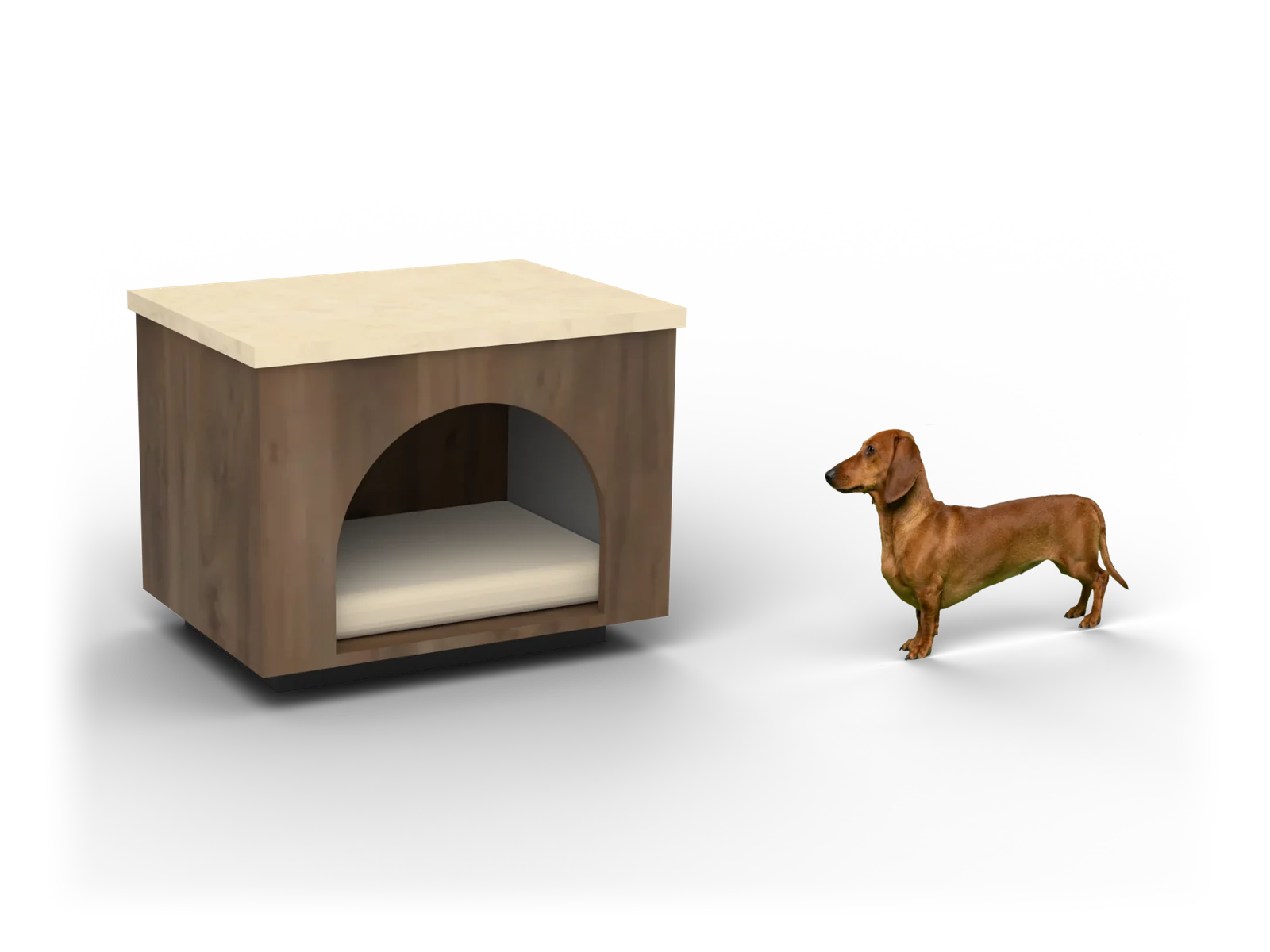
Size the den before anything else
Measure your dog standing: floor to the top of the shoulder blades, and nose to the base of the tail. Inside length is body length plus 15 cm. Inside height is 1.3 times shoulder height plus 8 cm. Inside width is 70% of the length. Round each to the nearest 5 cm. A Labrador at 58 cm and 78 cm long needs about 95 x 65 x 85 cm inside.
Then add the boards: two 19 mm sides, a top, a bottom and the base. A den for a large dog quickly makes a piece over 100 cm wide and 90 cm tall.
Boards, air and safety
- Use sealed boards with banded edges. Raw edges soak up moisture and splinter when chewed.
- Cut air slots high in the back and low in the base or the sides. A closed box gets warm quickly.
- Keep the opening wide enough for the dog to walk in straight, at least the shoulder width plus 10 cm.
- Put hinges, runners and screws where teeth cannot reach them. Round every edge inside the den.
- For short-muzzled breeds, build an open den with extra air.
Tools you will need
A track saw or a panel saw service for straight cuts, a jigsaw or router for the opening, an edge bander or iron-on edging, a drill with a drilling jig for hinges and runners, and clamps. Most DIY builds go wrong on square cuts and drawer runners, so have the boards cut to size by a supplier if you can.
When having it made is easier
If the dog is large, if the piece must fit a niche to the centimetre, or if you want drawers, a lift-up door and a finish that matches the kitchen, a DIY build gets long and expensive in tools. Our free 3D studio lets you design exactly the piece you would build, and we cut it on our CNC and build it for you. You see the drawing and a fixed price before you pay anything.
Checklist
- Measure the dog standing and lying stretched out.
- Work out the inside size with the rule above.
- Add the board thickness to get the outside size.
- Plan air slots and a wide opening.
- Keep hardware out of reach of teeth.