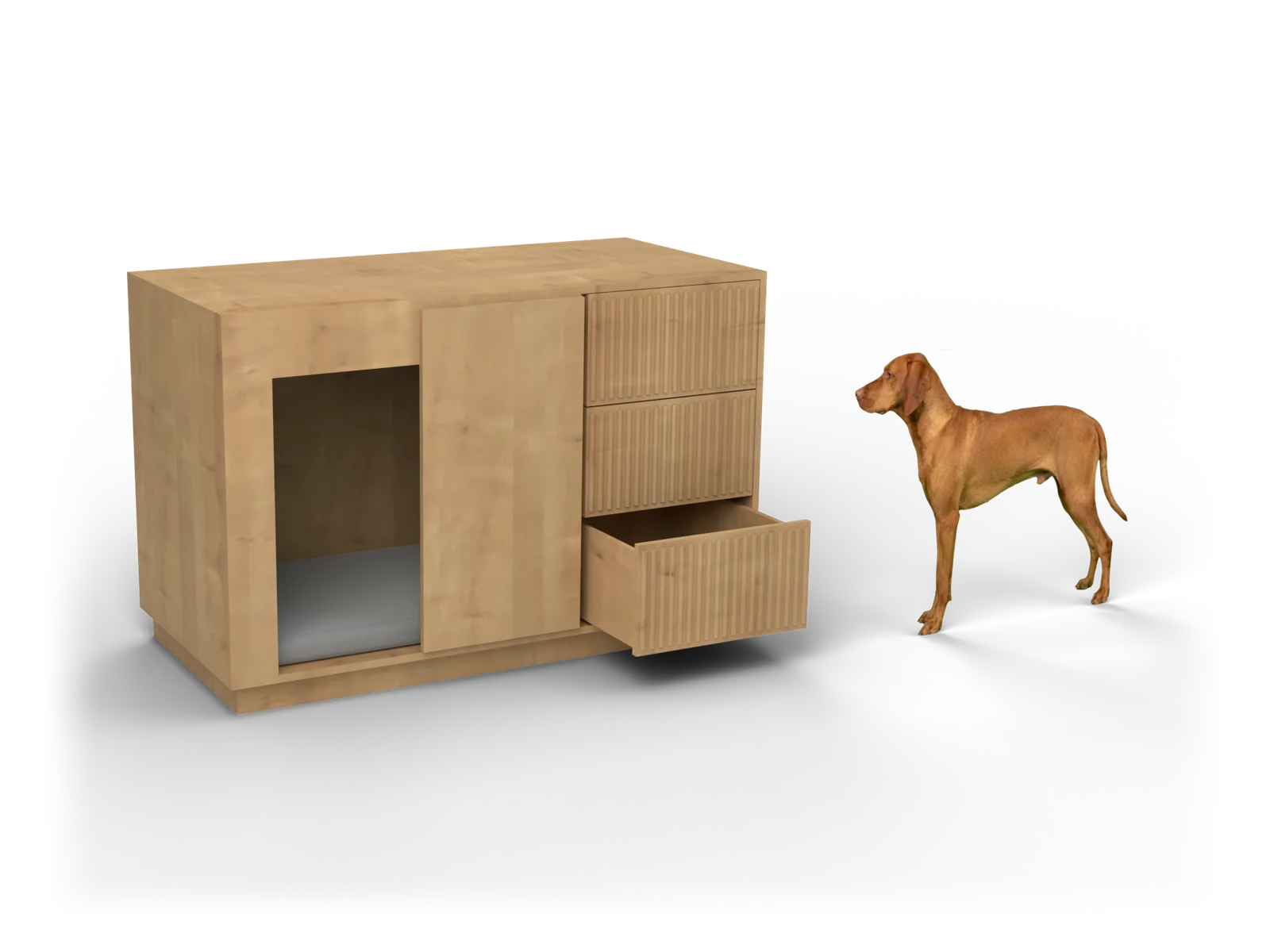
What dog crate furniture is
Dog crate furniture is a piece of furniture with a den built into it. A side table, a TV stand, a sideboard or a bench. The dog gets a quiet, covered place to sleep. You get a piece that belongs in the room instead of a wire cage.
Some pieces have a door and work as a real crate. Others stay open and are simply a den. Both are fine. The choice depends on your dog and how you train, not on the furniture.
Sizing from two measurements
You need two numbers. Shoulder height, measured from the floor to the top of the shoulder blades with the dog standing. Body length, from the tip of the nose to the base of the tail.
Our rule for the inside of the den: length is body length plus 15 cm. Height is 1.3 times shoulder height plus 8 cm. Width is 70% of the length. Round each to the nearest 5 cm.
A worked example. A Labrador stands 58 cm at the shoulder and measures 78 cm from nose to tail base. Length is 78 + 15 = 93, so 95 cm. Height is 1.3 x 58 + 8 = 83.4, so 85 cm. Width is 70% of 95, so 65 cm. A Beagle at 38 cm and 50 cm long gets a den of 65 x 45 cm, 55 cm high.
- Too small: the dog cannot turn round or lie flat on its side.
- Too big: the den stops feeling like a den, and a puppy may use one end as a toilet.
- Growing dog: size for the adult and use a removable spacer until it fits.
Ventilation and safety
A den is enclosed on most sides, so air has to get in and out. Look for air slots at the back and, ideally, at one side as well. A door should be ventilated across its whole face, not just a small grille.
Short-muzzled breeds need more care. French Bulldogs, Pugs and similar dogs cool themselves poorly. For them, choose an open den or one with extra rear air, keep it away from radiators and sunny windows, and use a light, washable fabric cover.
Check the details a dog will touch. Edges should be banded and rounded. Slats and gaps should be too small for a paw or jaw to get stuck in. Hinges and runners should sit outside the den, where teeth cannot reach them.
Door or no door
If you crate train, you need a door that closes and locks. A slatted or sliding door works well. It lets the dog see out and lets air through. Most trainers suggest short, calm sessions and never using the crate as a punishment.
If your dog is already settled, an open den is often better. It is cooler, easier to clean and easier to get in and out of. Many owners start with a door and remove it later. Ask whether the piece allows that.
Materials and finishes
Good crate furniture is built from sealed boards with banded edges, like the EGGER boards we use. The surface wipes clean and never needs oiling. EGGER makes hundreds of wood looks, plain matt colours and stone looks, so the piece can match a kitchen or floor you already have.
Inside the den, fabrics should come off and go in the wash. A zipped cover at 40 degrees is the simplest. A cushion that lifts out is quiet and easy to vacuum.
Hardware matters more than it looks. Drawers and doors next to a den get opened every day, often with a dog in the way. Soft-close runners and hinges, such as Blum, stay quiet and last.
Where it goes in the room
Dogs like to see their people. A den by the sofa or in the living room usually gets used. A den in a back corridor often does not.
Keep it away from heat sources, direct sun and the busiest walkway. Leave space in front of the opening so the dog can walk in straight. A side table works for dogs up to about 40 cm at the shoulder. Above that, a sideboard, TV stand or console is a better fit.
Ready-made or made to measure, and the cost
A ready-made crate table is the cheaper choice. If your dog fits a standard size and the look works in your room, it is often enough. The trade-off is fit. Standard sizes suit some dogs well and others badly, and the furniture rarely matches the rest of the room.
Made to measure costs more and takes longer. You get a den sized to your dog and a piece sized to your wall, in a finish that matches. At Barkitecture a side table with a den starts at about €1,150, sideboards at about €1,550 and TV stands at about €2,200, without transport, plus import VAT. Lead time is 6 to 10 weeks from the approved drawing.
The price follows size, finish and details such as drawers, doors and stone-look tops. A longer piece uses more board and more hardware. A drawn and fixed quote tells you the cost before you commit.
Checklist
- Measure shoulder height and nose to tail base, with the dog standing.
- Den length: body length + 15 cm. Height: 1.3 x shoulder + 8 cm. Width: 70% of length.
- Air slots at the back, and at one side if possible.
- Banded, rounded edges and no gaps a paw can get stuck in.
- Door only if you crate train, and fully ventilated if you do.
- Washable covers and linings.
- A spot near the family, away from radiators and direct sun.
- Outside size checked against the wall, the sofa arm and the door it has to pass through.